
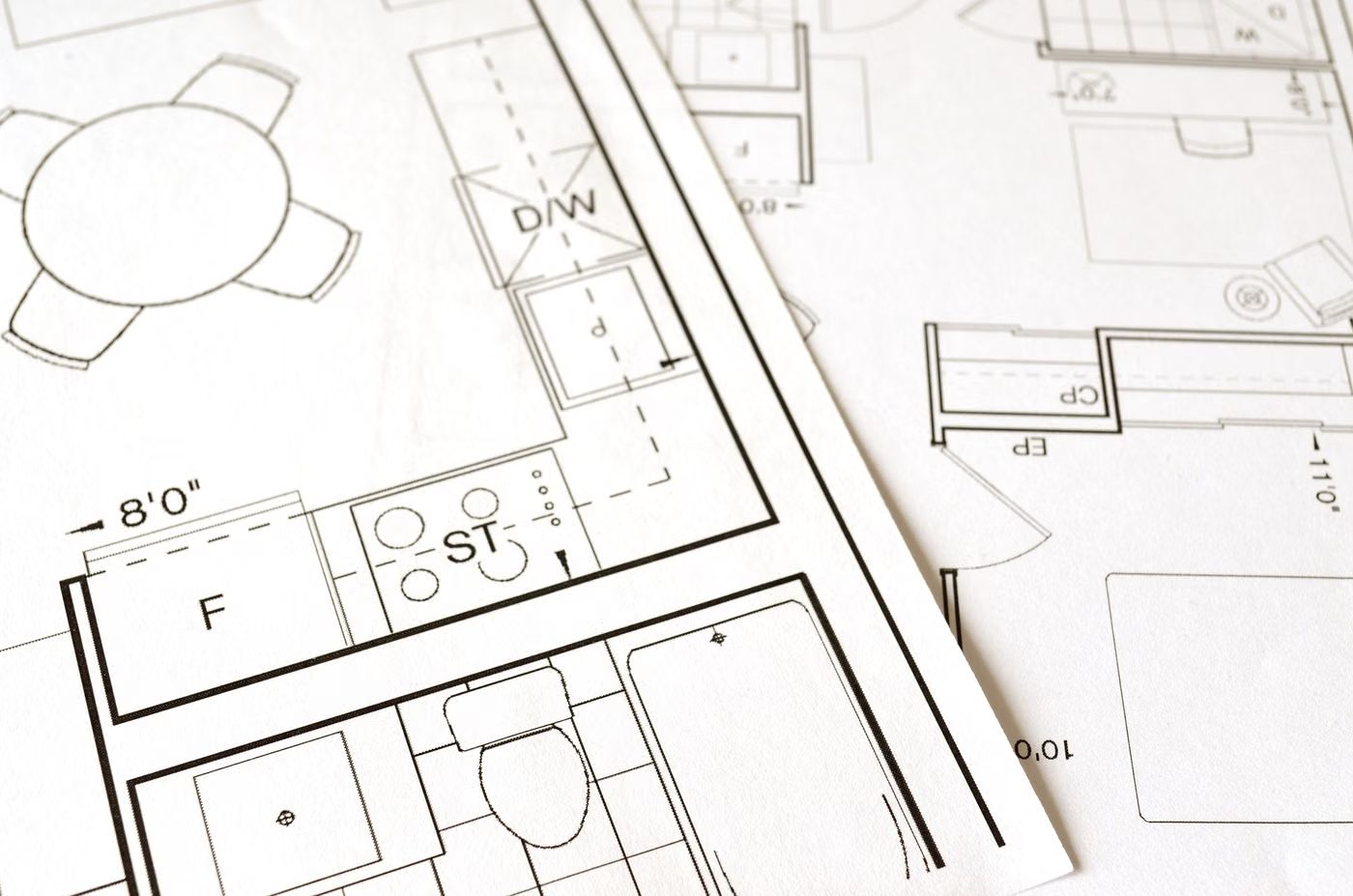
A bill of quantities (BOQ) is a document that lists every item of work in a construction project, with a measured quantity and a unit for each. Contractors price it line by line, which lets owners compare tenders on the same basis and gives both sides a shared reference for payments and variations.
This guide explains what goes into a BOQ, how it is prepared, and the checks that catch most errors before they cost money.
Where the BOQ sits in a project
Every line in the BOQ should trace back to a drawing reference and a measurement.
What a BOQ contains
| Part | What it does |
|---|---|
| Preliminaries | Site set-up, temporary works, insurances, management – costs not tied to a single element |
| Measured work | Items grouped by trade or element (concrete, reinforcement, masonry, finishes, MEP), each with description, unit and quantity |
| Provisional sums | Allowances for work that cannot yet be measured |
| Prime cost sums | Allowances for items supplied by nominated suppliers |
| Summary | Totals by section, carried to the tender total |
Anatomy of a BOQ line
| Item | Description | Unit | Quantity | Drawing ref. |
|---|---|---|---|---|
| 3.02 | Reinforced concrete C30 in ground-floor slab, 200 mm thick | m³ | 148.60 | S-101, S-102 |
| 3.03 | High-yield reinforcement, diameter 12 mm, in slab | kg | 9,420 | S-101, BBS-03 |
| 5.11 | Aluminium window W1, 1,500 × 1,800 mm, supply and install | nr | 24 | A-201 |
Illustrative example. Countable items (windows, doors, fittings) are measured in whole numbers; lengths, areas and volumes can carry decimals.
How a BOQ is prepared
- Agree the scope, the method of measurement and the BOQ structure (by trade, by element, or the client’s own template).
- Measure quantities from drawings, recording a drawing reference and every assumption.
- Log missing or conflicting information as design queries rather than guessing silently.
- Run an independent second check on the items that carry most of the cost.
- Issue the BOQ with the take-off sheets and the query log, so reviewers can trace any figure.
Take-off, BOQ and cost estimate: what is the difference?
| Term | What it is | Who uses it |
|---|---|---|
| Quantity take-off | The measurement work: quantities extracted from drawings | Quantity surveyors, estimators |
| Bill of quantities | The structured list of priced or unpriced items | Owners, contractors, tender teams |
| Cost estimate | Quantities multiplied by rates, plus allowances | Owners, cost consultants, lenders |
Seven checks before a BOQ goes to tender
- Every drawing in the issue list has been measured.
- Units match the item (whole numbers for countable items).
- Large items are re-checked independently.
- Quantities reconcile with a simple benchmark (e.g. concrete per m² of floor area).
- Descriptions state material, size and location clearly enough to price.
- Provisional sums are identified and explained.
- Open design queries are listed, not hidden in assumptions.
Why traceability matters
When a contractor or reviewer questions a quantity, the fastest answer is to show the drawing and the measurement behind it. BOQs without that link lead to long clarification rounds and disputed payments. We measure with QS Crystal, a take-off tool that keeps each quantity linked to its drawing reference, so every line in our bills can be traced.
Need a BOQ for your project?
MYDINHINCO prepares quantity take-off and bills of quantities for projects in Vietnam and abroad. Send us your drawings and we will reply with scope, timeline and a fee proposal.
Recent Works


